Blue Light and Sleep: What the Science Says
You've heard the advice: avoid screens before bed. But why does blue light specifically disrupt sleep, and is the science as clear-cut as popular culture suggests? Let's examine what decades of research reveal about light, melatonin, and the modern sleep crisis.
The Discovery of Melanopsin: A New Type of Photoreceptor
For decades, scientists believed the eye had only three types of photoreceptors: rods (for low-light vision), and three types of cones (for color vision). Then, in 2002, two research teams made a groundbreaking discovery.
Researchers led by Ignacio Provencio at Maryland and David Berson at Brown University independently discovered a fourth type of photoreceptor: intrinsically photosensitive retinal ganglion cells (ipRGCs) containing a light-sensitive protein called melanopsin (Hattar et al., 2002; Berson et al., 2002, both published in Science).
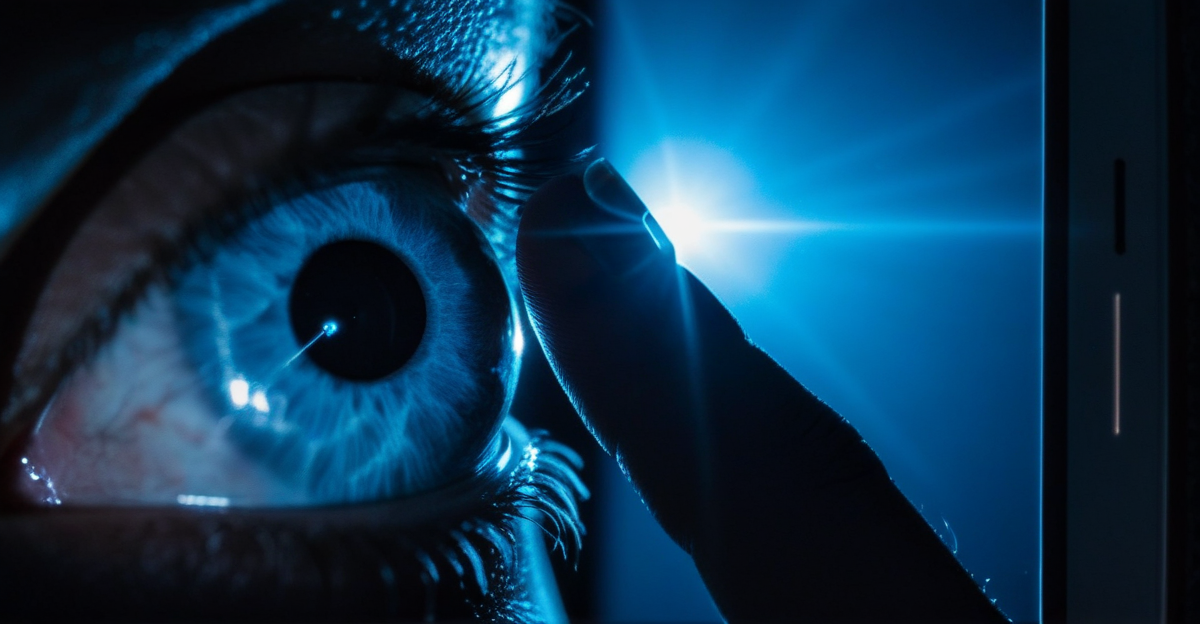
Unlike rods and cones, which send signals to the visual cortex for image formation, ipRGCs project directly to the suprachiasmatic nucleus (SCN)—the brain's master circadian clock. These cells are particularly sensitive to blue light wavelengths around 480 nanometers.
How Blue Light Suppresses Melatonin
The pathway is now well-understood:
- Blue light (460-480nm) enters the eye
- ipRGCs detect the light via melanopsin
- Signals travel via the retinohypothalamic tract to the SCN
- The SCN inhibits the pineal gland
- Melatonin production is suppressed
A pivotal study by Czeisler's team at Harvard (2005, Current Biology) demonstrated that just 6.5 hours of blue-enriched light exposure in the evening suppressed melatonin by 50% and delayed the circadian clock by nearly 3 hours.
The Evidence: Laboratory Studies
The Harvard Blue Light Study
In a carefully controlled experiment published in Current Biology (2010), researchers exposed participants to different light wavelengths. Key findings:
- Blue light (460nm) suppressed melatonin by 83%
- Green light (555nm) suppressed melatonin by only 35%
- Red light had minimal effect
- Even brief exposure (30 minutes) had significant effects
The Cambridge Mobile Device Study
Research by Harvard's Czeisler group (2015, Proceedings of the National Academy of Sciences) compared reading on an iPad versus a paper book before bed:
- Melatonin onset was delayed by 1.5 hours with the iPad
- Bedtime was delayed by 30 minutes
- Total sleep time decreased by 16 minutes
- Next-day alertness was reduced
Crucially, when the iPad's "night shift" feature (reduced blue light) was enabled, the effects were significantly diminished but not eliminated—suggesting content engagement also plays a role.
Real-World Studies: Screens and Sleep Quality
Adolescent Studies
Multiple studies have examined screen time and sleep in teenagers:
A study by Cain and Gradisar (2010) in Sleep Medicine Reviews found that adolescents with electronic devices in their bedrooms had:
- Later bedtimes
- Shorter sleep duration
- More difficulty falling asleep
- Greater daytime sleepiness
The UK Millennium Cohort Study
Following 11,000 children, researchers found that those with TVs in their bedrooms slept 25 minutes less per night than those without (Carter et al., 2014, Pediatrics).
But It's More Complex Than Just Blue Light
While blue light is important, researchers caution against oversimplification:
Content Engagement
Exciting or stressful content activates the brain, increasing cortisol and making sleep difficult regardless of light exposure. A study by LeBourgeois et al. (2017) in Pediatrics found that content type mattered as much as screen time.
Individual Differences
People vary in their sensitivity to light. A study by Brainard et al. (2001) found significant individual differences in melatonin suppression, possibly related to genetics and age.
Intensity and Duration Matter
The amount of light exposure matters. A dim phone screen at 11 PM may have less impact than bright overhead lighting at 9 PM. Research by Figueiro et al. (2011) showed that both intensity and duration affect melatonin suppression.
What About Blue Light Blocking Solutions?
Software Solutions
Apps like f.lux and built-in features (Night Shift, Eye Comfort Shield) reduce blue light emission. A study by Chang et al. (2015) found that using blue-light filtering glasses for 2 hours before bed:
- Increased melatonin levels by 58%
- Improved sleep quality scores
- Increased next-day alertness
Limitations
However, a 2019 systematic review by the American Academy of Sleep Medicine noted that while blue light filtering shows promise, evidence quality varies, and effects may be modest for some individuals.
Practical Recommendations Based on Evidence
Timing
The closer to bedtime, the more problematic blue light becomes. Research suggests:
- 2-3 hours before bed: Begin reducing screen time
- 1 hour before bed: Avoid screens if possible
- If screens are necessary: Use blue light filters, reduce brightness, increase viewing distance
Brightness
Studies show that lower brightness reduces melatonin suppression. The "20-20-20" rule adapted for evening: every 20 minutes, look 20 feet away for 20 seconds, and reduce screen brightness.
Alternative Light Sources
Research suggests warm-colored lighting (red/orange spectrum) has minimal circadian impact. Using dim, warm lights in the evening is better than bright white or blue-enriched lighting.
The Bigger Picture
Blue light is one piece of the sleep puzzle. Other factors matter too:
- Morning light exposure: Crucial for setting circadian rhythm
- Consistent sleep schedule: More important than perfect evening conditions
- Bedroom environment: Cool, dark, quiet
- Evening routine: Relaxation signals the body to wind down
Conclusion
The science is clear: blue light does suppress melatonin and can disrupt sleep, especially when exposure occurs close to bedtime. However, it's not the only factor—content engagement, individual differences, and overall sleep hygiene all matter. The goal isn't perfection but awareness and reasonable limits.
As Dr. Charles Czeisler notes: "The question isn't whether technology affects sleep—it does. The question is how we can use it wisely while protecting our sleep health."
References
- Berson, D. M., et al. (2002). Phototransduction by retinal ganglion cells. Science, 295(5557), 1070-1073.
- Brainard, G. C., et al. (2001). Action spectrum for melatonin regulation. Journal of Biological Rhythms, 16(6), 555-562.
- Cain, N., & Gradisar, M. (2010). Electronic media use and sleep. Sleep Medicine Reviews, 14(5), 329-338.
- Carter, B., et al. (2014). TV in bedroom and sleep duration. Pediatrics, 133(6), 1007-1014.
- Chang, A. M., et al. (2015). Evening use of light-emitting eReaders negatively affects sleep. Proceedings of the National Academy of Sciences, 112(4), 1232-1237.
- Figueiro, M. G., et al. (2011). Light intensity and melatonin suppression. Journal of Biological Rhythms, 26(2), 105-111.
- Hattar, S., et al. (2002). Melanopsin-containing retinal ganglion cells. Science, 295(5557), 1065-1070.
- LeBourgeois, M. K., et al. (2017). Screen time and sleep in adolescents. Pediatrics, 140(2), e20170978.